
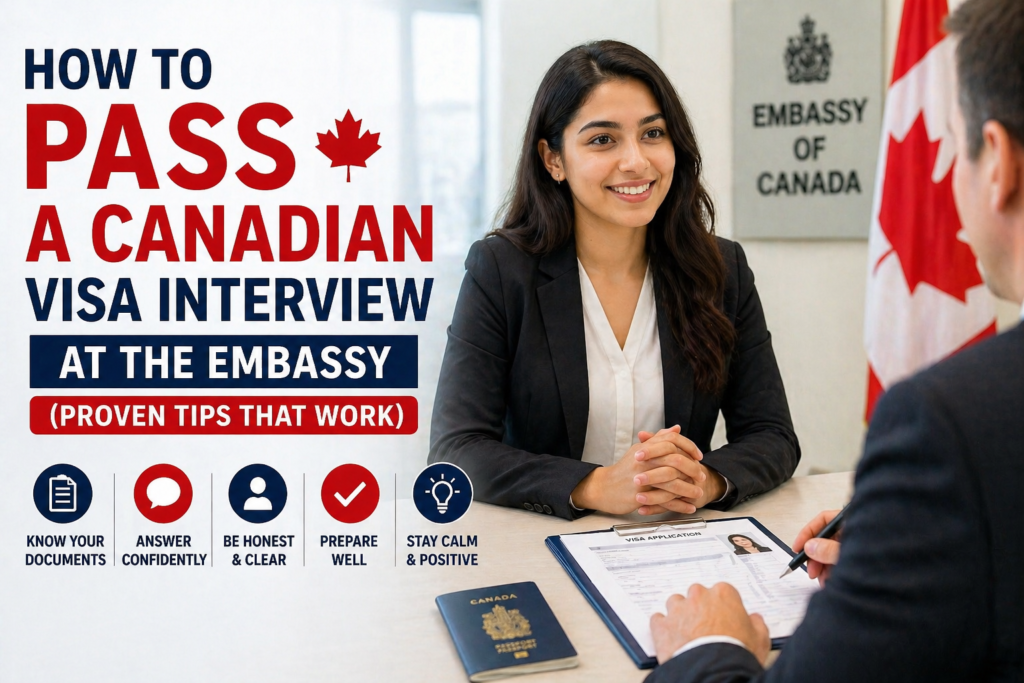
How to Pass a Canadian Visa Interview at the Embassy (Proven Tips That Work)
30 Apr 2026 • 11 min read • By Sure Jobs
Let me be honest with you right from the top.
Most articles about visa interviews are written by people who have clearly never sat in one of those hard plastic chairs, sweating through their shirt, watching a number board like their whole life depends on it.
I have. And so have about twenty of my friends and family members. Some got approved. Some got rejected for reasons that still make me angry. And some walked out confused, holding a refusal letter that said almost nothing helpful.
That’s why I’m writing this.
Not because I’m an immigration lawyer. I’m not. But because I’ve seen what actually works, what backfires, and what most websites won’t tell you about how to pass a Canadian visa interview at the embassy without losing your mind.
So grab a coffee. Take a breath. Let’s talk like real humans.
First, Let Me Bust a Myth for You
Here’s something nobody tells you: the Canadian visa interview is barely an interview.
Seriously. It’s not like the movies where someone shines a bright light in your face and demands to know your life story. Most of the time, it’s quiet. The officer types on their computer. They glance at your passport. They ask maybe three or four questions.
But that quietness? It’s actually a trap.
Because when they don’t ask much, you start rambling. You get nervous. You fill the silence with things you shouldn’t say. And before you know it, you’ve talked yourself into a refusal.
The secret isn’t being charming or funny. The secret is being boring. Boring, consistent, and completely predictable.
Sound weird? Stick with me.
What They’re Actually Looking For (Hint: It’s Not Your Personality)
Here’s the thing that took me years to understand.
The visa officer doesn’t care if you’re a nice person. They don’t care if you love Canada. They don’t care if you cried during that Tim Hortons commercial.
All they care about is one question: Will you come back home when your visa expires?
That’s it. Everything else—your bank statement, your job letter, your travel history—is just evidence to help them answer that one question.
So when you prepare, every single answer should quietly prove: I have a reason to return. A real one. A job. A family. A house. Something.
If you can’t make them believe that, nothing else matters.
Tip #1: Know Exactly What Kind of Visa You’re Asking For
You’d think this would be obvious. But I once watched a guy in line who kept calling his study permit a “work visa.” The officer corrected him twice. He still got it wrong. He was refused in under three minutes.
Don’t be that guy.
-
Visitor visa = tourism, family visits, short trips.
-
Study permit = school, college, university.
-
Work permit = a job, usually with an employer name attached.
Practice saying it out loud. “I’m applying for a visitor visa to see my sister.” “I’m applying for a study permit to attend the University of Toronto.”
If the words feel weird in your mouth, you haven’t practiced enough.
Tip #2: Your “Why Canada” Answer Needs to Be Boringly Specific
Most people mess this up immediately.
Officer: “Why do you want to go to Canada?”
Applicant: *”Because it’s beautiful and I’ve always wanted to see the mountains and everyone is so friendly…”
Stop right there. That answer is useless. It sounds like something you copied from Instagram.
Instead, try this:
“My cousin lives in Brampton. She had a baby last month. I’m going for two weeks to help her out and meet my new nephew. Here’s her invitation letter and her address.”
See the difference? One is a dream. The other is a plan.
Officers approve plans. They’re suspicious of dreams.
Tip #3: The Binder Trick (This Actually Works)
Okay, listen. You don’t need to spend money on fancy leather folders. But you absolutely need to organize your documents.
Here’s what I tell everyone to do:
Get a simple three-ring binder and a pack of plastic sleeves. Label five sections:
-
My forms (passport, application receipt, photo)
-
My money (bank statements, pay stubs, sponsor letter)
-
My job (employment letter, recent payslips, business registration if you have it)
-
My invitation (letter from whoever you’re visiting or the school acceptance letter)
-
My ties (property deed, lease, family documents—anything that proves you’ll go home)
When the officer asks for something, you don’t want to be rummaging through a messy backpack like you’re looking for a lost sock. You want to smoothly flip to the right section and hand it over.
That two-second moment of organization? It builds more trust than an hour of talking.
Tip #4: The Real Reason People Get Refused (Weak Ties)
Let me tell you about my friend Elena.
Elena had a decent job, some savings, and a clean record. She applied for a visitor visa to see her boyfriend in Montreal. At the interview, the officer asked: “What do you do for work?”
Elena said: “I’m a receptionist at a dental clinic.”
Then the officer asked: “What would happen if you didn’t go back to work?”
Elena shrugged and said: “They’d probably just hire someone else.”
She was being honest. But honestly got her refused.
Why? Because she basically admitted her job wasn’t a strong enough reason to return. In the officer’s mind, a replaceable receptionist could easily stay in Canada and never leave.
What should she have said instead? Something like:
“I’ve worked at that clinic for five years. The owner trusts me with scheduling and patient records. They’ve already approved my two weeks of vacation, and I’m expected back at my desk on June 15th. I wouldn’t risk losing that job.”
Same truth. Different framing. One sounds essential. The other sounds replaceable.
Tip #5: Practice the Questions That Make You Sweat
You know which questions I’m talking about. The ones that make your stomach drop.
-
“Have you ever been refused a visa before?” (If yes, just say yes. Don’t lie. Lying gets you banned for five years.)
-
“Do you have family in Canada?” (If yes, be honest. Having a relative isn’t a red flag unless you suggest you’ll live with them forever.)
-
“What will you do if we refuse your visa today?” (This one surprises people. I’ll give you an answer for it in a minute.)
-
“How did you get this money in your account?” (If a relative gave it to you, say so. They can smell lies.)
Get a friend or family member to quiz you. Out loud. In the mirror. In the shower. Until the answers feel natural, not robotic.
Tip #6: Dress Like You Respect the Room (Not Like a CEO, Not Like a Tourist)
You don’t need a thousand-dollar suit. I promise you that.
But please, please don’t show up in ripped jeans, flip-flops, or a hoodie with cartoon characters on it. I’ve seen it happen. It doesn’t go well.
Think: clean, comfortable, and careful.
-
A collared shirt or a simple blouse.
-
Pants that aren’t jeans (dark trousers or clean chinos work fine).
-
Closed-toe shoes you can walk in.
-
Hair brushed. Minimal cologne or perfume some officers are sensitive.
You’re not going to a wedding or a job interview. You’re going to a government office where people hold your future in their hands. Dressing like you care takes zero money and five extra minutes. Just do it.
Tip #7: Short Answers Save Your Life
I cannot stress this enough.
The officer asks: “How long will you stay?”
Do not say: *”Well, my friend lives in Vancouver and she’s been asking me to come for years, and I finally saved up enough money, and I wanted to see the mountains, and maybe also go to Toronto if there’s time, but I’m not sure how expensive it is, and…” READ ALSO: 20 Top Jobs In Canada For Foreigners and How To Apply (No Scams, No Fees)
Stop. Breathe. Say this instead:
*”Two weeks. From July 10th to July 24th. Here’s my return ticket.”
See? Sixteen words. Done.
Officers process hundreds of applications. They don’t need your life story. They need facts. Short facts. Verifiable facts.
The more you talk, the more chances you have to say something wrong.
Tip #8: What If The Officer Seems Mean?
Sometimes you’ll get an officer who looks grumpy. Maybe they interrupted you. Maybe they didn’t say hello back. Maybe they just stare at their screen for a long time without speaking.
Do not take this personally.
They might be tired. They might have just refused five people in a row. They might have a headache. It’s not about you.
Your job is to stay calm, polite, and patient. Don’t get defensive. Don’t argue. If they ask the same question twice, just answer it again, exactly the same way.
The moment you show frustration, they’ll think: “If this person can’t handle a five-minute interview without getting upset, how will they handle real problems in Canada?”
Smile. Breathe. Be boringly polite. It works every time.
Tip #9: Check Your Dates Like Your Life Depends On It
I’m serious about this.
I know someone who got refused because her invitation letter said she was visiting in “May 2025” but her application form said “June 2025.” The officer assumed she was lying about her plans. She wasn’t. It was a typo. Didn’t matter.
Go through everything with fresh eyes:
-
Does your employment letter match your resume?
-
Do your bank statements cover the exact period they asked for?
-
Is your name spelled exactly the same on every document?
-
Are your dates consistent?
Ask a friend to check too. Sometimes we miss our own typos because our brain fills in what it expects to see.
Tip #10: The One Sentence That Can Save You
Remember that tricky question I mentioned earlier? “What will you do if we refuse your visa today?”
Most people freeze. Or they look devastated. Or they get defensive.
Here’s what you say. Practice this until you can say it without crying or shaking:
“I’d be disappointed, of course. But I understand you have a difficult job. If that happens, I’ll review your concerns, gather whatever additional documents you suggest, and reapply when I’m ready.”
Why does this work? Because it shows maturity. It shows you’re not desperate. It shows you respect the process.
And ironically, sounding less desperate makes you more likely to be approved.
A Realistic Checklist For The Morning Of Your Interview
You’re going to be nervous. That’s fine. Here’s what actually helps:
-
Eat something small. An empty stomach makes the shakes worse.
-
Get there 30 minutes early. Not two hours. Not five minutes. Thirty.
-
Turn your phone OFF. Not silent. Off. A ringing phone in an embassy is a bad look.
-
Bring a book or headphones for the waiting room. Staring at the door will drive you crazy.
-
Use the bathroom before you go in. You don’t want to be shifting in your seat halfway through.
-
Speak clearly. If you’re nervous, slow down. It’s okay to pause. It’s okay to ask them to repeat a question.
-
Don’t lie. Not even a small lie. Not even to “help” your case. They’ve heard it all before.
What “Success” Actually Looks Like
Let me tell you about my cousin Maria.
Maria was a wreck before her student visa interview. She barely slept. She practiced her answers so many times that her roommate memorized them too.
When her number was called, she walked in shaking. The officer asked her three questions. Maria answered each one in under ten seconds. Her voice cracked on the last one.
Then the officer looked at her computer, typed for what felt like forever, and finally said: “Approved. Your passport will be ready in a week.”
Maria walked outside and burst into tears. Happy tears. Exhausted tears. The kind of tears that come after you’ve put everything on the line and someone says yes.
That could be you.
Not because you’re lucky. Not because you charmed anyone. But because you showed up prepared, told the truth, and proved that you understand what this whole thing really means.
One Last Thing Before You Go
If you walk out of that embassy with a refusal, it’s not the end.
I know it feels like it. I’ve seen grown adults cry in their cars in the embassy parking lot. It’s devastating.
But here’s what I’ve learned: thousands of people get refused the first time and approved the second. They fix whatever the officer pointed out. They save more money. They get a stronger job letter. They try again.
The only real failure is giving up.
So go prepare. Practice in the mirror. Organize that binder. Eat something. Breathe.
And when you walk into that room, remember: the officer isn’t your enemy. They’re just a person doing a hard job. Your job is to help them say yes.
You’ve got this. I really believe that.
Quick disclaimer: I’m not a lawyer or an immigration consultant. I’m just someone who’s been through this circus and watched a lot of other people go through it too. Immigration rules change all the time. Always double-check the official IRCC website before your interview. But the human stuff? The nerves, the preparation, the honesty? That part never changes.
Leave a Reply