
How To Apply for a Canadian spousal visa (Family Class Sponsorship)
Let’s be real for a second. Applying for a Canadian spousal visa (officially called the Family Class Sponsorship) can feel less like a romantic milestone and more like a part-time job you never applied for.
If you’re lying awake wondering, “Did we upload the right photo?” or “Is that one trip to Niagara Falls enough proof?” breathe. I’ve been in those shoes. The good news? Canada actually wants families to be together. Unlike some countries that make you jump through fiery hoops, Canada’s system is surprisingly humane if you know the rhythm.
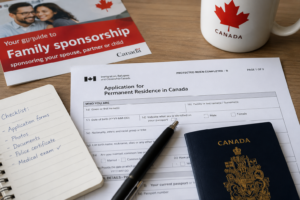
Here is the no-fluff, realistic walkthrough on how to get that visa approved without losing your mind.
Step 1: The “Are We Legit?” Check (Eligibility)
Before you open a single PDF, you need to see if you qualify. There are two sides to this coin:
The Sponsor (You, the Canadian/Permanent Resident):
- You must be at least 18 years old.
- You are a Canadian citizen or Permanent Resident living in Canada (though citizens living abroad can sponsor, it gets trickier).
- You aren’t in prison, bankrupt (from a sponsorship perspective), or under a removal order.
- Crucial: You haven’t been sponsored as a spouse yourself within the last 5 years.
The Applicant (Your spouse, coming to Canada):
- Also at least 18.
- You have a genuine relationship. This is the big one. Canada cares less about how long you’ve known each other and more about whether the relationship is real.
The Relationship Reality Check:
- Married: You need a legal, valid marriage certificate. Sorry, common-law partners don’t count here unless you’re actually married.
- Common-Law: Lived together for at least 12 consecutive months (no big breaks). Lease agreements and joint bills are your best friends.
- Conjugal: This is rare. Usually for couples who face legal barriers to living together (e.g., same-sex couples in unsafe countries). If you just don’t want to get married yet, this doesn’t apply.
Step 2: The “Inland vs. Overseas” Headache
This is where most people get stuck. You have two pathways. Choose wisely.
- Outland Sponsorship (Spouse lives outside Canada): The classic route. Your spouse stays in their home country while you apply.
Pro: Faster processing usually (12 months-ish).
Con: They can’t visit easily during the wait.
- Inland Sponsorship (Spouse lives in Canada): Your spouse comes to Canada on a visitor visa first, then you apply from inside.
Pro: They can apply for an Open Work Permit so they can get a job while waiting.
Con: If you leave Canada during processing, you might get denied re-entry.
My hot take: If your spouse just wants to get here and start working, go Inland with the Open Work Permit. If they have a good job back home and can wait it out, go Outland (it’s usually less stressful administration-wise).
READ ALSO: How to Pass a Canadian Visa Interview at the Embassy (Proven Tips That Work)
Step 3. The Monster: The Application Kit
You need to download the IMM 5289 (for Outland) or IMM 5288 (for Inland).
Open a bottle of wine. You’ll need it.
The kit has about 10-15 forms. The scary ones are:
- IMM 1344 (Sponsorship Agreement): You are legally promising to support your spouse for 3 years so they don’t go on welfare.
- IMM 5532 (Relationship Information): This is the “prove your love” section.
How to Actually Prove Your Love (Without Being Weird)
You need to show IRCC (Immigration, Refugees and Citizenship Canada) that this isn’t a $5,000 fake marriage scheme.
The Gold Standard Documents:
- Photos: 10-15 good ones. Include wedding photos, but also boring ones, Halloween 2022, a backyard BBQ, holding a fish on a pier. Caption every photo (Date, location, occasion).
- Chat Logs: Seriously. Export your WhatsApp or iMessage history. You don’t need 10,000 pages. Print one page per month showing consistent, loving, boring conversation. (Pro tip: Highlight a few sweet messages).
- Money Trail: Joint bank account statements, e-transfers for rent, a shared credit card. Even sending your spouse $20 for pizza counts.
- Travel Evidence: Boarding passes, hotel bookings, passport stamps. If you said you visited Paris, prove you both had the flu in that tiny Airbnb.
Don’t send: Love letters written in crayon. Cringe wedding videos. A binder with 400 selfies. Keep it professional, warm, and organized.
Step 4. The Fees (The Unromantic Part)
You can’t skip this. Total cost is roughly 1,135CAD (1,135CAD (1,080 if no biometrics).
- Sponsor fee: $75
- Principal applicant: $490
- Right of Permanent Residence fee: $515 (pay this upfront, or they’ll delay your file asking for it later).
- Biometrics: $85 (fingerprints and photo).
Pay online. Print the receipt. Put it in the application. Do not lose this receipt.
Step 5. Submit & The “Waiting Vortex”
Once you mail that giant envelope (or upload it online if you applied digitally), the waiting game begins.
- AOR (Acknowledgement of Receipt): This takes 6-8 weeks. If you don’t get it, they lost your file. (Yes, it happens. Call them.)
- Biometrics Request: Your spouse goes to a Visa Application Centre (VAC) in their country. Wear a nice shirt, because that photo will be on their PR card for 5 years.
- Medical Exam: IRCC will send a letter. Your spouse must see an IRCC-approved panel physician. Not their family doctor. You pay ~$200 for this.
- Eligibility Interview: Rare, but possible. They just want to see if you know each other. They might ask: “Where did you meet?” “What side of the bed does your spouse sleep on?” “What’s their mom’s name?” If you know the answers, you’re fine.
Step 6. The Email You’ve Been Waiting For (Passport Request)
After 10-14 months of refreshing your email 47 times a day, you get it: “Ready for Visa” (RFV).
Your spouse sends their passport to the visa office. They stamp it. They send it back with a shiny Confirmation of Permanent Residence (COPR).
Warning: Do NOT book a flight until you have the passport back in hand. I know you’re excited. Wait.
Step 7. Landing Day (The Airport “Interview”)
When they land at Pearson or Vancouver, they will talk to a border officer. The officer will ask:
- “Are you bringing any firearms?” (Say no.)
- “Do you have any criminal charges?” (Say no.)
- “You know you can’t sponsor another spouse for 5 years?” (Say yes.)
They sign the COPR. That’s it. They are now a Permanent Resident.
The Emotional Reality Check (Read This)
Here is what the government doesn’t tell you: The wait is brutal.
You will fight over the phone. You will have days where you think, “We should have just moved to Mexico instead.” You will see families together at the grocery store and feel a pang of jealousy.
But when that passport comes back with the visa? When they walk through the arrivals gate and the customs officer says, “Welcome home”? Every frustrated hour spent scanning boarding passes becomes worth it.
One last piece of advice: Join a Facebook group like “Canada Spousal Sponsorship Support Group.” The members there know more about specific visa officers than the government helpline does. Misery loves company, but in this case, that company will save your sanity.
You’ve got this. Go get your person.
Disclaimer: I’m a human who did this successfully, not a lawyer. Immigration rules change. Always check the official IRCC website for the most current forms and fees.