
Finance and Immigration Planning: The Complete Guide Nobody Gives You Before You Move
Most people who plan to immigrate to another country spend months, sometimes years, researching visa categories, language requirements, documentation processes, and application timelines. They become experts in immigration law. They know exactly which forms to submit and in what order. They understand the points-based system or the family sponsorship route or the employer nomination pathway down to the finest detail.
And then they arrive in their new country completely unprepared for what the financial side of that move actually looks like.
Not because they are careless or unintelligent. But because nobody told them. The immigration industry focuses almost entirely on getting people through the visa door. What happens to your money, your credit history, your taxes, your retirement savings, your banking access, and your financial identity once you step through that door is a conversation that rarely happens until something goes wrong.
READ ALSO Credit Cards and Travel Abroad, Things You Need Know
This post is that conversation. It covers the financial planning that should happen before, during, and after the immigration process, so that when you arrive in your new country you are not starting from zero financially even if you are starting from scratch in every other way.
Whether you are planning a move to Canada, Australia, the United Kingdom, Germany, the United States, or anywhere else, the financial principles and planning frameworks in this post apply. Adjust the specific details for your destination, but the structure of thinking about money and immigration together is universal.
Why Finance and Immigration Planning Must Happen Together
Immigration and financial planning are almost always treated as separate conversations. Your immigration lawyer handles the visa. Your family handles the goodbye. And you figure out the money when you get there.
This separation is expensive. Not just in dollars or pounds or euros, though it is certainly that. It is expensive in time, in opportunity, and in the kind of stress that comes from navigating a new country while also scrambling to establish basic financial functionality from nothing.
The people who transition most smoothly into life in a new country are almost universally the ones who treated their financial preparation with the same seriousness they gave their visa application. They arrived with money that was accessible. They understood what their new country’s banking system required of new arrivals. They knew how their home country tax obligations would continue or end. They had a clear picture of what the first six months would cost before they happened. And they had specific plans for building credit, accessing financial services, and beginning to accumulate wealth in their new home from day one.
That level of preparation does not require a financial advisor, though one can certainly help. It requires the right information and a willingness to think through the financial dimensions of the move while there is still time to act on them.
This post gives you that information.
Start With a Complete Financial Inventory Before You Leave
The first practical step in combined immigration and financial planning is creating a thorough, documented picture of where you stand financially right now, before anything changes.
This means listing every asset you own including savings accounts, investment accounts, retirement funds, property, vehicles, business interests, and any other store of value. It means listing every liability including mortgages, personal loans, credit card balances, student loans, and any other debt. The difference between these two numbers is your net worth, and knowing it precisely matters because immigration affects it in ways you cannot anticipate if you do not know your starting point.
Document every financial account with its institution name, account number, current balance, and the contact information for the institution. Store this documentation securely in both physical and digital formats, in locations you will be able to access from your new country. The ability to quickly provide this information when needed for tax filings, financial applications, or banking purposes in your new home will prove valuable many times over.
Gather several years of tax returns from your home country. Immigration authorities in many destination countries ask for evidence of financial history, and your home country tax records are one of the most authoritative sources of that history. Even after you leave, your home country may continue to have tax claims on certain types of income, and having accurate historical records makes managing those obligations significantly easier.
Understand your credit history before you leave. Pull a full credit report from your home country and review it carefully. If there are any errors or unresolved issues, address them now. Your home country credit history does not travel with you to your new country, but it is a resource that some financial institutions in your destination may be willing to consider as evidence of your creditworthiness, especially if you can present it in a well-documented format.
How Much Money Do You Actually Need to Immigrate
This is the question most people ask too late, after they have already committed to a timeline that does not give them enough time to save adequately.
The honest answer is more than most immigration resources suggest, because those resources typically cover the direct costs of the immigration process itself without accounting for the full financial reality of establishing a life in a new country.
The direct costs of immigration include visa application fees, which vary enormously by country and category but can range from a few hundred to several thousand dollars. Medical examination fees required by many immigration authorities. Document translation and certification costs. Legal fees if you are using an immigration lawyer or consultant, which many people do and which adds substantially to the total. Biometrics and processing fees. In some countries, a settlement fund requirement where you must demonstrate to the immigration authority that you have sufficient funds to support yourself upon arrival without needing public assistance.
Beyond these direct costs, the real financial preparation is about what comes after arrival. Most people significantly underestimate the cost of the first three to six months in a new country.
Before your first paycheck in your new country, assuming you are moving for employment, you will likely have paid for flights for yourself and potentially your family. You will have paid for temporary accommodation while you search for a permanent rental. You will have paid for the security deposit on that rental, which in many countries is equivalent to one to two months of rent paid upfront. You will have purchased essential household items and appliances, because even if you shipped belongings, gaps always exist. You will have bought local SIM cards, navigated transportation in an unfamiliar city, and paid for food in a market where you do not yet know where the affordable options are. You will have potentially paid fees to open a bank account, obtain a local ID, and register with relevant government agencies.
A realistic financial preparation for immigration to a high-cost country like Canada, Australia, or the United Kingdom means having the equivalent of at least six months of your projected living expenses in accessible savings, on top of all the direct immigration costs. For a family, this figure increases proportionally.
Many immigration programs have minimum financial requirements that are lower than this realistic figure. Meet the immigration minimum but plan your savings toward the realistic number.
Managing Your Money in the Months Before You Move
The period between deciding to immigrate and actually leaving is when your financial decisions have the most leverage over your eventual outcome. Here is how to use that time well.
Build your savings aggressively and keep them liquid. This is not the time for long-term investments that require notice periods or lock-in terms to access. The money you are saving for the move needs to be available quickly and ideally in a currency or account structure that makes international access practical. High-yield savings accounts that offer easy online access and international transfer capability are appropriate for this purpose.
Understand the tax implications of selling assets before you leave. If you sell property, investments, or a business before emigrating, the gains from those sales may be taxable either in your home country, your destination country, or both, depending on the specific countries involved and the timing of the sale relative to your tax residency status. This is one of the areas where professional tax advice specific to cross-border situations adds genuine value. The tax cost of an ill-timed asset sale can be significant, and getting the timing right can legally save you a meaningful amount.
Reduce and ideally eliminate high-interest debt before you leave. Carrying expensive consumer debt into an immigration transition creates compounding financial pressure at exactly the time when you have the least financial flexibility. If you cannot eliminate debt entirely, at minimum understand the terms and know exactly what you will owe and when while you are in the midst of settling into a new country.
Consider your banking structure carefully. Having a bank account in your home country that you maintain after departure is almost always a good idea, particularly for the first year or two. You will likely continue to receive certain payments there, need to manage ongoing obligations, and require the ability to move money between countries. Choose a home country bank that offers good international transfer options and reasonable fees for receiving and sending international transfers.
Research the banking requirements of your destination country well in advance. Many countries require proof of address before a bank account can be opened, which creates a frustrating catch-22 for new arrivals who need a bank account to receive a salary but need proof of address to open a bank account and cannot get proof of address without having established accommodation which requires money in a local account. Understanding this specific challenge for your destination and researching which banks or financial products offer solutions for new arrivals without proof of address allows you to plan a way around it.
The Credit History Problem and How to Solve It
This is the financial challenge that surprises immigrants more than almost any other. When you arrive in a new country, your financial history is invisible to that country’s credit system. Decades of responsible borrowing and repayment in your home country count for nothing because credit bureaus do not share data across international borders in most cases.
You arrive as a financial ghost. No credit score. No credit history. In many countries, this means you cannot rent an apartment without a larger deposit or a guarantor. You cannot get a credit card with a meaningful limit. You cannot finance a car or access a mortgage for years. You are financially invisible in a system that bases almost every financial decision on a history you simply do not have yet.
This is not a permanent situation. It is a temporary one, but it requires active management to resolve faster than the default timeline would suggest.
The first step is opening a bank account as soon as possible after arrival. Even a basic account establishes your relationship with the financial system and creates the starting point from which credit history can be built.
Apply for a secured credit card as soon as you are eligible. A secured card requires you to deposit money as collateral, typically equal to the credit limit of the card. You use the card for normal purchases and pay the balance in full each month. The card issuer reports your payments to the credit bureau, and over time those on-time payments build your credit history. It is slower than what you were used to at home, but it is the most reliable pathway to credit establishment available to new immigrants.
Some credit unions and community banks in immigrant-heavy areas have specific products designed for new arrivals that recognize this challenge and offer pathways to credit establishment that the major banks do not. Research what is available in your specific destination city.
In Canada, a program called the Newcomer Banking Program is offered by several major banks including RBC, BMO, and TD specifically for new immigrants and addresses many of the initial banking barriers. In the United Kingdom, some banks offer accounts designed for new arrivals that do not require proof of address in the traditional sense. In Australia, most major banks will open an account for migrants before they arrive, allowing them to bring accessible funds. Research the specific options in your destination country and city before you arrive.
If you have an internationally recognized credit card such as American Express, ask your issuer about their Global Card Transfer program. American Express specifically offers a program that allows existing cardholders who are moving to a new country where Amex operates to apply for a card in that country with their existing credit history considered, even without a local credit score. This is a genuinely valuable option for Amex cardholders making an international move.
Keep meticulous records of your home country credit history, including your credit reports, bank statements showing consistent savings and responsible financial behavior, and documentation of any loans taken out and paid off on time. Some financial institutions in your destination country will consider this information informally, and having it organized and presentable gives you the best chance of it being taken into account.
Understanding Your Tax Obligations in Two Countries
Taxes are the area of immigration financial planning that carries the greatest potential for expensive mistakes, and they are the area where the specifics of your particular situation and the two countries involved make generalizations the most dangerous.
That said, there are several principles that apply broadly enough to be worth understanding before you get into the specifics of your situation.
Most countries tax their residents on worldwide income. When you become a tax resident of your new country, the income you earn anywhere in the world is generally taxable there. If you continue to earn income from your home country after you have left, whether from a rental property, investment income, a business, pension payments, or any other source, you need to understand how both countries tax that income and whether a tax treaty between the two countries prevents double taxation.
Tax treaties are bilateral agreements between countries that establish which country has the right to tax specific categories of income and provide mechanisms to avoid the same income being taxed twice. Many pairs of countries have these treaties, and they are among the most important documents to understand when you are moving between two countries with income sources in both. Your home country’s tax authority website and your destination country’s tax authority website will both publish information about applicable treaties.
Tax residency is determined differently from immigration residency. You can be a permanent resident for immigration purposes in your new country while still being considered a tax resident of your home country for part of the year, or you can be considered a tax resident of your destination country even before your immigration status is finalized. The rules for establishing and ending tax residency vary by country and in some cases depend on the number of days spent in each country during a tax year.
Exit taxes are applied by some countries when a person ceases to be a tax resident there. The United States is particularly well known for this, applying a departure tax on certain high-net-worth individuals who renounce citizenship or give up long-term permanent residency. Canada also applies a deemed disposition rule when a person leaves Canada, treating certain assets as if they had been sold on the departure date and potentially triggering capital gains tax. Understanding whether your home country imposes any form of exit tax and how it is calculated is an important part of your pre-departure financial planning.
Retirement savings and pension accounts present particular complexity in cross-border situations. Contributions to retirement accounts in one country may or may not be recognized by the other country’s tax system. Withdrawals from retirement accounts after you have moved abroad may be subject to withholding taxes and may also be taxable in your new country of residence. Some pension systems allow emigrants to receive payments while living abroad while others require you to convert or access the funds before departure. Understanding the specific rules that apply to your home country retirement accounts before you leave can save you from costly mistakes years later when you try to access those funds.
The consistent advice from every financial professional who works with immigrants is to consult a tax professional who specializes in cross-border taxation specific to your two countries before you leave. This is not generic advice given reflexively. The tax mistakes that immigrants make, particularly around the timing of departure, the treatment of home country assets, and the management of ongoing home country income, are genuinely costly and largely avoidable with the right advice given at the right time.
Remittances: Sending Money Back Home Efficiently
For most immigrants, particularly those from developing countries, sending money back to support family members at home is not optional. It is a regular and significant financial obligation that needs to be planned for as part of the household budget in the new country and managed as efficiently as possible to minimize the amount lost to transfer fees and unfavorable exchange rates.
The global remittance industry is enormous and the range of providers, services, and pricing varies enormously. At one end of the spectrum, traditional bank wire transfers are reliable but typically expensive, with fees that include both a flat transfer fee and a margin built into the exchange rate. At the other end, digital remittance services have disrupted the market significantly in the past decade, offering faster transfers, more favorable rates, and lower fees by operating with more efficient infrastructure.
Services like Wise, which was previously called TransferWise, have built a strong reputation for offering exchange rates very close to the mid-market rate with transparent, low fees. Remitly, WorldRemit, and Sendwave are other services that operate in major remittance corridors and offer competitive pricing. The specific best option depends on the corridor between your new country and your home country and the delivery method preferred by your recipient.
Before settling into a habit with any particular remittance service, compare rates across several options for the specific amount you send and the specific currency pair you need. The difference in effective cost between the best and worst options for a specific corridor can be surprising and the savings from switching to a better provider add up meaningfully over time.
Timing remittances to take advantage of favorable exchange rate movements is a strategy that some people pursue, though it requires monitoring exchange rates and carries the risk that the rate moves against you while you are waiting. For most people, the consistency of sending on a regular schedule is more manageable and produces acceptable outcomes without the complexity of trying to time currency markets.
If you send remittances regularly, it is worth understanding the tax implications in both countries. In your destination country, money sent abroad is generally sent from after-tax income and is not deductible in most standard tax situations though there are some exceptions. In your home country, the recipients of remittances generally do not pay tax on money received as a gift or family support in most jurisdictions, but this should be confirmed for your specific home country’s rules.
Building Wealth in Your New Country From the First Year
Getting the basics functioning, the bank account opened, the paycheck arriving, the accommodation sorted, is only the beginning of the financial life you are building in your new country. The immigrants who build lasting financial security are the ones who start thinking about wealth accumulation from the earliest possible point rather than waiting until they feel completely settled.
The wealth-building tools available in your new country may be different from what you were familiar with at home, and understanding them early creates the habit of using them correctly from the start.
Employer-sponsored retirement plans are one of the most important wealth-building vehicles available in countries like Canada, Australia, the United States, the United Kingdom, and others, and they are frequently underutilized by immigrants who are unfamiliar with them or who assume they are temporary residents who will not benefit from long-term retirement savings in their new country. Even if you are not certain about your long-term plans, contributing to an employer-sponsored retirement plan from your first year captures any employer matching contributions, which are literally free money added to your retirement savings that you forfeit if you do not participate.
Tax-advantaged savings accounts are available in most developed countries and offer significant long-term wealth-building benefits for those who use them consistently. Canada’s Tax-Free Savings Account allows Canadians and permanent residents to invest and grow money completely free of tax on the growth and withdrawals. The United Kingdom’s Individual Savings Account operates on a similar principle. The United States offers Roth IRAs that allow tax-free growth and withdrawals in retirement. Understanding which tax-advantaged accounts are available to you in your new country and beginning to use them from as early as you are eligible is one of the most impactful financial decisions a new immigrant can make.
Property ownership is a significant wealth-building pathway in many destination countries, though it requires time to build the credit history and savings that support mortgage eligibility in a new country. Setting a realistic timeline for property acquisition, understanding the local property market and mortgage qualification requirements, and making saving for a down payment an explicit financial goal from early in your immigrant journey gives this aspiration a realistic plan behind it.
Investing in locally listed index funds or exchange-traded funds through a local brokerage account is accessible relatively quickly after arrival and allows you to begin building a long-term investment portfolio in your new home currency. The same principles of consistent, diversified, long-term investing that apply anywhere apply in your new country, and beginning early even with modest amounts takes advantage of the compounding effect over your career horizon.
Insurance Planning for Immigrants
Insurance is one of the most practically important and most commonly overlooked dimensions of financial planning for immigrants. Arriving in a new country without adequate insurance coverage creates financial vulnerability that can undo months or years of savings in a single event.
Health insurance is the most urgent priority. In countries with public healthcare systems like Canada, Australia, and the United Kingdom, you may have a waiting period before your eligibility for public coverage begins. Ontario, Canada, for example, has historically had a three-month waiting period for new residents to become eligible for provincial health insurance. During this gap, private health insurance is essential. Research the specific waiting period and public coverage rules for your destination province or region and purchase private coverage to bridge the gap.
In countries without universal public healthcare like the United States, health insurance obtained through your employer or purchased independently is not optional. Medical costs without insurance in the United States can be catastrophically expensive, and a single significant health event without coverage can result in financial devastation.
Life insurance needs to be reviewed and potentially re-established in your new country. A life insurance policy purchased in your home country may not pay out if you are living abroad, or the terms may have changed when your residency status changed. Check the specific policy terms and obtain new coverage in your destination country if needed.
Property and contents insurance is a basic but important coverage that many new renters overlook because it is not always required by landlords and its value is not always apparent until something goes wrong. Renters insurance, which covers your personal belongings against theft, fire, and other covered losses, is typically affordable and worth having from the moment you have belongings in your new accommodation.
Disability insurance, which replaces a portion of your income if you are unable to work due to illness or injury, is another coverage that is easy to overlook but genuinely important, particularly for immigrants who do not yet have the financial reserves that might sustain a household through an extended period without income.
The Psychological Dimension of Financial Transition
This is not something most financial planning guides talk about, but it is real and it matters.
Moving to a new country involves a profound psychological adjustment, and that adjustment has a direct impact on financial decision-making. The disorientation of a new environment, the loneliness of an early immigrant experience, the anxiety of feeling like you are starting over, and the social pressure of appearing to be doing well in your new country when finances are actually tight all create conditions where financially irrational decisions are more likely.
Overspending on things that create a sense of normalcy or belonging in a new environment is one of the most common financial patterns among early immigrants. Buying more than you need to furnish a new home, eating out more than planned because it is easier than learning a new grocery system, spending on entertainment and social activities out of a need to connect rather than genuine enjoyment, these are understandable human responses to a difficult transition that can significantly derail financial plans.
The immigrants who navigate this most successfully are the ones who set their financial plans and spending frameworks before they leave, when they are in a rational, planful mindset, and then hold themselves accountable to those plans during the emotionally heightened early period of the move. Having a written budget for the first six months, including allowances for settling-in costs and social spending, and treating it as a commitment rather than a suggestion makes an enormous difference.
It also helps to connect with communities of people who have made the same move you are making. Immigrant communities in most major cities, both physical and online, are rich sources of practical financial knowledge specific to your home country and your destination. People who made the move before you know which banks are most welcoming to new arrivals, which neighborhoods offer better value for rent, where to shop affordably, which insurance products are overpriced, and dozens of other practically valuable pieces of information that save real money.
Five Years Out: What Financial Success as an Immigrant Looks Like
It is worth stepping back from the immediate tactical concerns to describe what financial success as an immigrant looks like over a five-year horizon, because having a clear vision of the destination makes navigating the individual steps more purposeful.
By the end of your first year, the foundation should be established. You have a functioning bank account, a credit card you are using to build history, a clear understanding of your tax obligations in both countries, appropriate insurance coverage, and a budget that allows you to save a consistent percentage of your income.
By the end of your second year, your credit score in your new country should be developing meaningfully. You are contributing to a retirement savings plan. You have an emergency fund covering at least three months of expenses in your new country. Your home country financial obligations are organized, understood, and managed efficiently.
By the end of your third year, you are beginning to think about longer-term wealth accumulation with a realistic timeline for property ownership or expanded investment. Your income has likely grown as you have established yourself professionally. Your lifestyle spending is calibrated to a budget that allows consistent saving and investing.
By years four and five, the financial foundation of a genuinely stable life in your new country is real. The early scramble and uncertainty have been replaced by a clear picture of where you stand, where you are going, and what the path between those two points looks like.
This timeline is not automatic. It is the result of making good financial decisions consistently from the moment you start planning the move, treating the financial dimension of immigration as seriously as the visa dimension, and being patient with a process that takes time to mature.
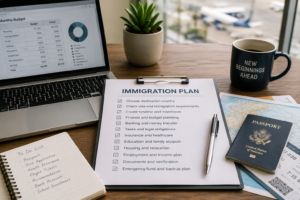
Your Immigration Financial Planning Checklist
Before you leave your home country, make sure you have done these things. Not as a formality but as genuine preparation that will serve you immediately and for years after arrival.
Create a complete financial inventory of everything you own and everything you owe. Get certified copies of your tax returns for the past three to five years. Pull and document your credit history. Research the banking options for new arrivals in your destination country. Understand the immigration financial requirements for your visa category and ensure you genuinely meet them with an appropriate buffer. Consult a cross-border tax professional who understands both your home country and destination country tax systems. Research the remittance options for sending money home if this applies to you. Purchase travel and health insurance that bridges any gap before public coverage begins. Understand what your home country’s rules are around retirement savings and pensions when you leave. Make a written budget for your first six months including realistic estimates for all the settling-in costs that immigration guides typically omit.
Every one of these items, addressed before your departure, removes a potential crisis from your first year in your new country and creates the financial stability from which everything else can be built.
Final Thoughts
Immigration is one of the most significant decisions a person can make, and it deserves to be approached with the full seriousness it warrants, including in its financial dimensions. The people who build genuinely good financial lives in their new countries are not the ones who were lucky or who happened to arrive with more money. They are the ones who understood that the financial planning and the immigration planning are not two separate things. They are two halves of the same preparation.
You are not just moving your body from one country to another. You are moving your financial life, your earning potential, your tax obligations, your credit identity, and your wealth-building trajectory. The more deliberately you plan all of it together, the more smoothly that transition goes and the faster the life you are building in your new country begins to reflect the ambition and effort that brought you there in the first place.
Start that planning now, while there is still time for the decisions you make to have their full effect.
This post is for informational and educational purposes only and does not constitute financial, tax, immigration, or legal advice. Every individual’s situation involves unique factors, and the rules governing taxation, banking, and immigration vary significantly by country. Always consult qualified professionals for advice specific to your circumstances and the countries involved in your move.