
Emergency Fund vs Investment: Which Comes First?
There is a question that quietly torments almost everyone who starts taking their money seriously. You have finally gotten your spending under control. You have a little extra cash left over at the end of the month for the first time in years. And now you are staring at two doors. Behind one door is a savings account, safe and boring, where your money will earn almost nothing but will always be there when you need it. Behind the other door is the stock market, where your money has the potential to grow significantly over time but could also lose value at exactly the moment you need it most.
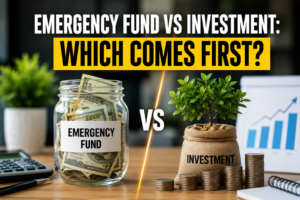
Which door do you walk through first?
This question matters more than most people realize, because the order in which you build financial security shapes everything that comes after it. Get the sequence wrong, and you can find yourself liquidating investments at a loss during a crisis, or worse, going into debt to cover an emergency because every dollar you had was tied up somewhere you could not easily reach. Get the sequence right, and you build a foundation that lets you invest with genuine confidence instead of constant low-grade anxiety.
Let us work through this carefully, because the honest answer is more nuanced than the financial advice you usually hear.
READ ALSO Best Passive Income Ideas in 2026: Real Ways to Earn Money While You Sleep
What an Emergency Fund Actually Does for You
An emergency fund is not really a savings strategy. It is an insurance policy that you fund yourself instead of paying a company to provide. Its entire purpose is to absorb the financial shock of the unexpected: a job loss, a medical bill, a car repair, a broken appliance, a sudden family need. Life produces these events on a schedule no one can predict, and the only real question is whether you will face them with cash already set aside or with panic and debt.
The psychological value of an emergency fund is just as important as the financial value, and it is the part that gets discussed far less often. People who have a few months of expenses sitting in an accessible account report dramatically lower financial anxiety than people with the same income who do not. That reduced anxiety changes behavior. It makes people less likely to make impulsive financial decisions, less likely to take a job purely out of desperation, and more likely to negotiate confidently because they are not negotiating from a place of fear.
There is also a practical investing reason an emergency fund matters, and it is the crux of this entire discussion. Investments, particularly stock market investments, are only valuable to you if you can leave them alone long enough for compounding and market recovery to work in your favor. The single worst thing that can happen to an investor is being forced to sell during a downturn because they need the cash for something urgent. An emergency fund is what stands between you and that forced sale. It is, in a very real sense, what protects your investments by absorbing the shocks that would otherwise require you to disturb them.
What Investing Actually Does for You
Investing is how you put your money to work growing over time instead of simply sitting still. Cash in a regular bank account loses purchasing power every year due to inflation. Even cash in a competitive high-yield savings account in 2026 is typically only keeping pace with inflation rather than meaningfully outgrowing it. Investing, particularly in a diversified portfolio of stocks held over a long time horizon, has historically been the most reliable way for ordinary people to build wealth that actually grows in real terms.
The mathematics of investing reward time more than almost any other factor. Money invested in your twenties has decades to compound before retirement. Money invested in your forties has far less runway. This is why so much financial advice emphasizes starting early, even with small amounts, rather than waiting until you feel fully ready.
But investing comes with a condition that is easy to underestimate when markets are calm and easy to feel painfully when markets are not: your money can lose value, sometimes significantly, in the short term. A portfolio that is up thirty percent over a decade might be down twenty percent in any individual year along the way. If you need that money during one of those down years, you are forced to sell at a loss, turning a temporary paper decline into a permanent, real one.
The Core Tension Explained Simply
Here is the entire conflict in one sentence: emergency funds protect you from being forced to sell investments at the worst possible time, but money sitting in an emergency fund is money that is not growing the way invested money grows.
This is why the conventional, widely taught financial planning answer is not “emergency fund first” or “investing first” as an absolute rule, but rather a specific sequence that most certified financial planners and reputable personal finance educators converge on. Understanding that sequence, and more importantly understanding why it exists, will let you apply it intelligently to your own situation rather than following it blindly.
The Sequence Most Financial Experts Recommend
The first step in almost every reputable financial planning framework is building a starter emergency fund before doing any investing beyond the bare minimum. This starter fund is typically smaller than a full emergency fund, often somewhere between five hundred and two thousand dollars depending on your circumstances. Its purpose is narrow and specific: to prevent a minor financial surprise, a flat tire, a dental bill, a broken laptop, from turning into high-interest credit card debt. This starter fund exists before any serious investing begins, because the math of paying eighteen to twenty-five percent interest on credit card debt overwhelms almost any realistic investment return you could earn during the same period.
The one common exception that financial educators almost universally agree on is employer-matched retirement contributions. If your employer offers a 401k match, contributing enough to capture the full match typically happens even before the starter emergency fund is complete, because an employer match is an immediate, guaranteed return on your money that no market investment can rival. Walking away from free matching money to build savings faster is, in almost every case, the wrong trade.
Once the starter emergency fund and any available employer match are in place, the next priority for most people is paying off high-interest debt, which functions financially as a guaranteed negative investment return that needs to be eliminated before other goals make sense.
After high-interest debt is handled, the focus shifts to building a full emergency fund, typically covering three to six months of essential living expenses. This is the stage where the bulk of the emergency fund versus investing tension actually plays out, and it deserves its own careful examination.
Only once the full emergency fund is substantially built do most financial frameworks recommend shifting primary financial energy toward investing for long-term goals, whether that is retirement, a home purchase, or general wealth building.
How Big Should Your Full Emergency Fund Actually Be?
The standard advice of three to six months of expenses is a reasonable starting point, but it is not a one-size-fits-all number, and treating it as such is one of the more common mistakes people make in this part of their financial planning.
Your ideal emergency fund size depends heavily on the stability and nature of your income. Someone with a stable government job, strong job security, and a working spouse with independent income can reasonably target the lower end of that range, or even slightly below it. Someone who is self-employed, works on commission, has variable income, or works in an industry prone to layoffs should generally target the higher end of the range or beyond it, sometimes building toward nine or even twelve months of expenses.
Your fixed obligations also matter. Someone with a mortgage, dependents, and significant fixed monthly costs needs a larger cushion than someone who is single, renting, and has minimal fixed obligations and the flexibility to cut expenses quickly if needed.
Your access to other resources matters too. Someone with family who could provide a short-term loan in a true emergency, or someone with a home equity line of credit already established as a backup, may reasonably feel comfortable with a somewhat smaller cash cushion than someone with no such backup resources available.
The honest answer to how large your emergency fund should be is that it is the number that lets you sleep soundly at night and would genuinely cover your real expenses through a realistic worst-case disruption to your income, given your specific circumstances.
Why Building Both Simultaneously Often Makes More Sense Than Strict Sequencing
The textbook sequence described above is a useful mental framework, but real financial lives rarely move in such clean, linear stages, and a growing number of thoughtful financial educators now recommend a more blended approach for many people.
Consider someone in their late twenties with stable income, no high-interest debt, and only a small starter emergency fund. Telling this person to put one hundred percent of their available savings toward a full six-month emergency fund before investing a single additional dollar means potentially delaying investing by a year or two. Given how powerfully time affects investment compounding, that delay has a real, measurable cost.
A more balanced approach that many planners now suggest is splitting available monthly savings between the emergency fund and long-term investing simultaneously once high-interest debt is cleared and the starter fund is in place. Someone might direct sixty percent of their savings toward building their full emergency fund and forty percent toward an investment account, gradually building both at once rather than fully completing one before starting the other.
This blended approach works particularly well for people with relatively stable income and a reasonable risk tolerance, because it captures some of the time advantage of earlier investing while still making consistent progress toward a fully funded safety net. It tends to work less well for people in unstable income situations, where the priority should lean more heavily toward the safety net until it is robust.
Where to Actually Keep Your Emergency Fund
A detail that gets less attention than it deserves is where your emergency fund should physically live, because this decision significantly affects both its safety and its modest earning potential.
An emergency fund should never be invested in the stock market, in cryptocurrency, or in any asset whose value can decline meaningfully in the short term. The entire purpose of this money is reliability and immediate access, not growth. Putting your emergency fund into investments defeats its core purpose and reintroduces the exact risk it exists to protect against.
The right home for an emergency fund is a high-yield savings account, a money market account, or in some cases short-term treasury instruments that remain highly liquid. These options provide modest interest, meaningfully better than a typical checking account, while preserving the immediate accessibility and capital stability that an emergency fund requires.
Keeping your emergency fund at a different institution than your everyday checking account is a strategy many people find helpful, not because of any technical financial advantage, but because of the psychological friction it introduces. Money that requires a deliberate transfer between institutions is less likely to get casually spent on something that does not qualify as a true emergency.
Common Mistakes People Make With This Decision
One of the most common mistakes is treating investing as inherently superior to saving because of the higher potential returns, without weighing the very real risk of being forced to sell during a downturn. People who skip building any meaningful emergency fund and put every available dollar into the market often discover the cost of this decision at the worst possible time, when a job loss coincides with a market downturn and they are forced to sell depreciated assets simply to cover rent.
The opposite mistake is just as costly, even though it feels safer. People who build enormous emergency funds, sometimes a year or more of expenses, far beyond what their actual risk profile requires, and who keep delaying investing indefinitely “until they feel ready,” lose years of compounding growth to excess caution. Money sitting in a savings account earning a modest yield while inflation erodes its purchasing power is not actually safe in the way it feels safe. It is simply exposed to a different, quieter kind of risk.
Another frequent mistake is failing to revisit the emergency fund target as life circumstances change. Someone who built a three-month emergency fund as a single renter and then bought a home, had children, or became self-employed often needs a substantially larger cushion than they originally calculated, but rarely goes back to recalculate and rebuild after the original number was reached.
A Practical Framework You Can Actually Use
Rather than memorizing a rigid rule, it helps to think through this decision as a short series of honest questions about your own situation.
Do you currently carry high-interest debt, such as credit card balances? If so, addressing that debt, after securing any available employer retirement match, should take clear priority over both a full emergency fund and additional investing, because the guaranteed cost of that debt outweighs almost any realistic alternative use of the money.
Do you have at least a small starter emergency fund, enough to cover a minor unexpected expense without going into debt? If not, building this small cushion first, even before serious investing, protects you from the most common and disruptive small financial shocks.

Once those two conditions are met, how stable is your income, and how large are your fixed financial obligations? The less stable your income and the larger your obligations, the more weight should shift toward building a substantial emergency fund before significantly ramping up investing. The more stable your income and the more flexible your expenses, the more comfortable you can be building both simultaneously, or leaning somewhat more toward investing once a reasonable partial emergency fund is established.
Finally, are you walking away from any employer matching contributions by not investing? If so, capturing that match, within reason, typically remains worth prioritizing even while your emergency fund is still being built, because of the immediate guaranteed value it represents.
Conclusion
There is no universal answer that applies identically to every person, because the right sequence depends on your debt, your income stability, your obligations, and your personal tolerance for financial uncertainty. But there is a sensible general order that serves most people well: a small starter emergency fund first, then high-interest debt elimination, then a full emergency fund built either before or alongside long-term investing depending on your income stability, with employer-matched retirement contributions captured throughout the entire process whenever they are available.
The deeper principle underneath all of this is that emergency funds and investments are not actually competitors for your money. They serve different jobs in your financial life. The emergency fund’s job is to absorb shocks so the rest of your financial life can stay stable. The investment’s job is to grow your wealth over time using money you will not need to touch for years. A financial plan that respects both jobs, rather than treating one as inherently more important than the other, is the plan that actually holds up when life happens, which it inevitably will.
Build the safety net. Then build the wealth. And once you have a reasonable foundation under you, build both at the same time, with intention, and watch how much more confidently you are able to invest once you are no longer investing out of fear.