
Top STEM Scholarships for Tech Students in 2026
3 Jun 2026 • 31 min read • By Sure Jobs
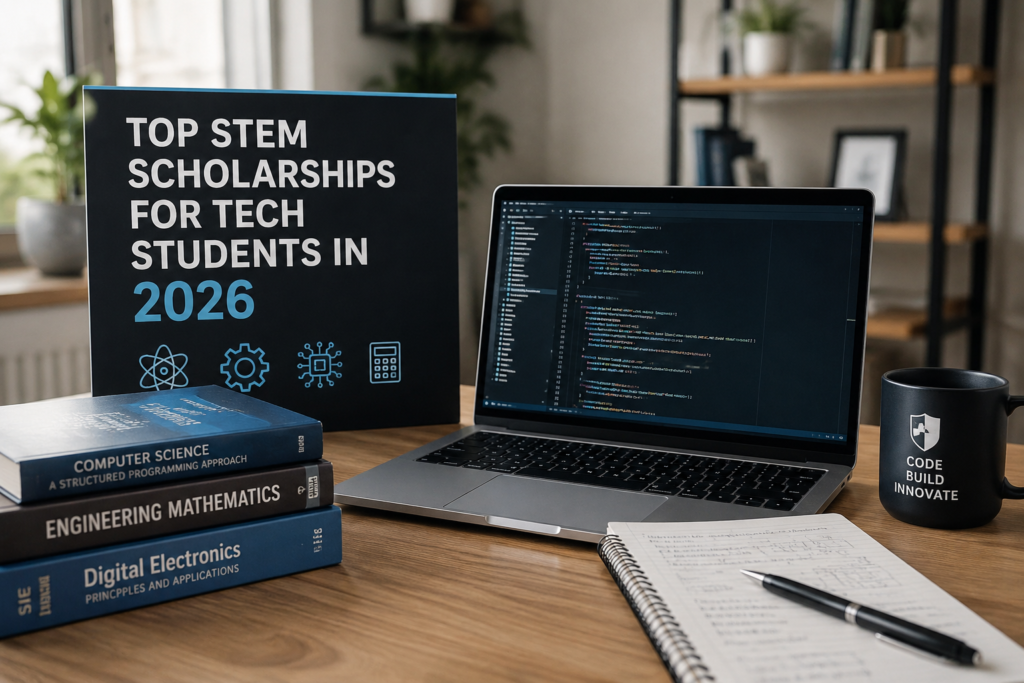
Top STEM Scholarships for Tech Students in 2026
There has never been a better time to be a tech student, and there has never been a more expensive time to become one. Tuition costs continue to climb. Living expenses in university cities are rising faster than most families can comfortably absorb. And the student loan burden that follows many graduates into their careers has become one of the defining financial anxieties of an entire generation. Yet at the same time, the demand for skilled technology professionals has never been higher, and the organisations that depend on that talent pipeline, from Silicon Valley giants to government agencies to nonprofit research labs, have responded by pouring serious money into STEM scholarships that go far beyond token gestures.
The scholarships available to STEM students in 2026 are remarkable in their scope, generosity, and diversity of focus. Some are fully funded packages that cover tuition, housing, and a monthly stipend. Others provide one-time awards large enough to cover a full year of study. Many come with mentorship connections, internship placements, and professional networks that outlast the scholarship itself by decades. Taken together, they represent a genuine opportunity for students who are willing to do the research and put in the application work.
This guide is written for tech students at every stage, whether you are a high school senior preparing to enter university, an undergraduate midway through your degree, a recent graduate heading into a master’s program, or a working professional looking to return to school for advanced study. The scholarships covered here span a wide range of fields within STEM, including computer science, software engineering, cybersecurity, data science, artificial intelligence, electrical engineering, mechanical engineering, biomedical engineering, mathematics, physics, and more.
What you will find in this guide is not a recycled list of scholarship names with a sentence of generic description attached to each. What you will find is a thorough look at the most significant, accessible, and genuinely valuable STEM scholarship opportunities in 2026, along with honest context about what each one offers, who it is designed for, and what a strong application looks like.
Why STEM Scholarships Have Grown So Significantly in Recent Years
Understanding the landscape requires understanding the forces driving it. The growth in STEM scholarship funding over the past decade is not accidental. It reflects a set of converging pressures that show no sign of reversing.
The global technology industry is experiencing a structural talent shortage that no amount of hiring optimism has been able to resolve. Despite high-profile layoffs at some large technology companies in recent years, the underlying demand for people who can build software, secure systems, analyse data, develop algorithms, and engineer hardware continues to outpace supply. Organisations that rely on this talent have concluded that the most rational long-term investment is to help create more of it, which means funding education.
READ ALSO How to Build Wealth From Scratch in Your 20s
Government agencies in the United States, the United Kingdom, the European Union, Australia, and elsewhere have reached a parallel conclusion from a national security and economic competitiveness perspective. STEM fields underpin defence systems, critical infrastructure, public health technology, climate solutions, and economic productivity. No country that wants to remain competitive in any of these areas can afford to leave talent on the table because the cost of education priced out the students who would have filled these roles.
Meanwhile, diversity within STEM has remained a persistent challenge. Women, students from low-income backgrounds, first-generation college students, and students from underrepresented racial and ethnic groups are still significantly underrepresented in computer science, engineering, and related disciplines at both the undergraduate and graduate levels. A substantial and growing portion of STEM scholarship funding is specifically directed at addressing this gap, not as charity but as a strategic recognition that a wider talent pool produces better science, better technology, and better outcomes.
The result of all of this is a scholarship ecosystem that is larger, better funded, and more varied than it has ever been. For students who take the time to navigate it well, the financial barriers to a quality STEM education are more surmountable than the headline tuition numbers suggest.
The Gates Scholarship
The Gates Scholarship, funded by the Bill and Melinda Gates Foundation, is one of the most comprehensive and prestigious undergraduate scholarships available to students in the United States. It is specifically designed for exceptional, Pell-eligible minority students who are pursuing degrees in STEM, education, or public service, with a strong and consistent emphasis on STEM disciplines.
What the Gates Scholarship provides is genuinely remarkable. It is a last-dollar scholarship, meaning it covers the full cost of attendance at the recipient’s chosen college or university after other financial aid has been applied. This includes tuition, room and board, books, personal expenses, and transportation. It is renewable for up to five years of undergraduate study, which provides real financial security for students pursuing demanding programs that occasionally require more than four years to complete.
Beyond the financial support, Gates Scholars gain access to a community of peers, mentors, and alumni that has been built intentionally over more than two decades. This network is active, supportive, and genuinely useful in ways that go well beyond the scholarship years themselves.
Eligibility is limited to U.S. citizen or permanent resident students who identify as American Indian or Alaska Native, Asian and Pacific Islander American, Black American, or Hispanic American. Students must also demonstrate significant financial need as defined by Pell Grant eligibility and must be entering their first year of undergraduate education at a U.S. college or university. A minimum GPA of 3.3 is required, though competitive applicants typically present significantly stronger academic records.
The application process is detailed and requires substantial effort. Students must submit an application through the Gates Scholarship portal, complete essays, provide academic documentation, and secure letters of recommendation. The application typically opens in the late summer preceding the academic year and closes in mid-September. Competition is fierce, with thousands of applicants vying for a relatively small number of annual awards. But for students who meet the eligibility criteria, the reward is transformative.
The Regeneron Science Talent Search
The Regeneron Science Talent Search holds the distinction of being the oldest and most prestigious science and mathematics competition for high school students in the United States. Since its founding in 1942, it has served as a launching pad for careers that have produced Nobel laureates, Fields Medal recipients, and some of the most significant scientific breakthroughs of the past century.
This is not a traditional scholarship application. It is a research competition. Students submit original research projects in any area of science, mathematics, or engineering, and the judging is done by working scientists and engineers who evaluate the quality, originality, and significance of the work itself. The top 300 scholars each receive a $2,000 award and recognition. The top 40 finalists are invited to Washington, D.C., for a week of events, judging, and engagement with the broader scientific community. From among the finalists, awards totaling $1.8 million are distributed, with the top prize sitting at $250,000.
For high school students who are genuinely passionate about research and science, the Regeneron Science Talent Search is about far more than prize money. It is a signal to universities, future employers, and the scientific community that a student is doing real, serious work. Many of the most selective universities in the world actively recruit Regeneron finalists and scholars. The experience of conducting independent research, writing it up in a format suitable for competition, and defending it before expert judges builds the kind of intellectual confidence and scientific identity that carries forward into an entire career.
The National Science Foundation Graduate Research Fellowship Program
For students entering graduate school in a STEM field, the National Science Foundation Graduate Research Fellowship Program is the gold standard of fellowship support in the United States. Established in 1952, it is the oldest graduate fellowship program of its kind in the country and remains among the most competitive and prestigious.
The fellowship provides a monthly stipend of $37,000 per year, paid directly to the fellow, plus a $16,000 cost-of-education allowance paid to the fellow’s institution. This combination is enough to fund graduate study at essentially any university in the United States with meaningful financial freedom. The fellowship is awarded for a total of five years, of which three years can be used for active study and research. Fellows have significant flexibility in when they use their funded years, which allows for creative academic planning.
Eligibility is limited to U.S. citizens, nationals, and permanent residents. Students must be in the early stages of their graduate career, generally meaning that applicants must be in their first or second year of graduate school, or applying in their final year of undergraduate study. The fellowship is open to all STEM fields that the NSF supports, which covers the natural sciences, mathematics, computer science, engineering, social sciences with a quantitative emphasis, and STEM education research.
The application requires a research plan, a personal statement, and letters of recommendation. It is evaluated by panels of scientists and engineers who look for intellectual merit, which means the quality and originality of the proposed research, and broader impacts, meaning the potential for the work to contribute to society and to inspire future generations. Strong applications present a specific, well-developed research question, demonstrate clear understanding of the relevant literature, and articulate convincingly why the proposed approach is promising.
The NSF GRFP is awarded to approximately 2,000 students annually out of roughly 12,000 to 13,000 applicants, making the acceptance rate around 16 percent. For students who receive it, the fellowship does more than fund graduate school. It signals to the academic and research community that the fellow’s work has been independently validated as among the most promising in their field.
The Microsoft Research PhD Fellowship
Microsoft Research has been one of the most influential industrial research labs in the world for more than three decades, and its PhD Fellowship reflects that commitment to advancing fundamental research. The fellowship is specifically aimed at doctoral students in North America who are working on research with potential for long-term impact in areas relevant to Microsoft’s research interests.
Relevant areas include artificial intelligence and machine learning, computer vision, natural language processing, hardware and systems, programming languages and software engineering, security and privacy, human-computer interaction, computational biology, and mathematical sciences. This is a broad scope that covers much of what is most exciting and consequential in computing research today.
The fellowship provides full tuition coverage for two years, a generous annual stipend, and a conference travel allowance. Equally importantly, it comes with a mentorship assignment from a Microsoft Research scientist, giving fellows a direct connection to researchers who are doing genuinely frontier work in their area.
Applicants must be nominated by their faculty advisor, which means building a strong relationship with a doctoral supervisor who believes in the significance of your work is a prerequisite. The nomination-based structure also means that the fellowship tends to go to students who are already producing work of recognisable quality. If you are early in your doctoral program, working toward the point where your advisor would enthusiastically nominate you is the right framing for how to think about this fellowship.
The Google PhD Fellowship
Google has been running its PhD Fellowship program since 2009, and it has become one of the most sought-after sources of support for doctoral students working at the intersection of computer science, engineering, and applied research. The fellowship is available in the United States, Canada, Europe, the Middle East, Africa, Asia Pacific, and India, making it one of the more globally accessible corporate-funded research fellowships in STEM.
Fellows receive full tuition support and a stipend that varies by region but is consistently generous, along with a Google Research Mentor from within the company. The fellowship is awarded across a range of research areas that Google has defined as priorities, including algorithms, optimisation and markets, computational neuroscience, health and bioscience, human-computer interaction and visualisation, machine learning and data mining, mobile computing, natural language processing, privacy and security, programming technology and software engineering, quantum computing, robotics and autonomous vehicles, social and economic networks, systems and networking, and structured data and database management.
Like the Microsoft Research fellowship, the Google PhD Fellowship is nomination-based, requiring the student’s faculty advisor to submit a nomination on the student’s behalf. This structure reflects the fact that the fellowship is designed to support research that is already showing genuine promise, and the faculty advisor is the most authoritative voice on whether a student’s work qualifies.
For doctoral students whose research connects to Google’s areas of interest, this fellowship provides not only financial support but a professional connection to one of the world’s leading technology organisations during the critical years when academic and career trajectories are being shaped.
The Adobe Research Fellowship
Adobe Research runs a fellowship program aimed at PhD students doing research in areas relevant to Adobe’s products and platforms. While this may sound narrow, Adobe’s technical scope is actually quite broad. Research areas of interest include computer vision, machine learning and deep learning, natural language processing, graphics and rendering, human-computer interaction, digital media analysis, augmented and virtual reality, and computational photography.
The fellowship provides a stipend, conference travel support, and access to Adobe Research internship opportunities. The internship component is particularly valuable because it connects fellows with Adobe’s research scientists and engineers in a hands-on setting that can lead to publications, long-term collaborations, and career opportunities.
This fellowship is an excellent option for PhD students who are working on technically creative problems at the intersection of computing and media, creativity, and communication, domains where Adobe has been investing in genuinely ambitious research for many years.
The Palantir Scholarship for Women in Technology
Palantir Technologies has operated a scholarship program specifically for women pursuing undergraduate degrees in computer science, engineering, and related technical fields for many years. The program is oriented around the belief that increasing the representation of women in technology requires concrete financial support, not just encouragement.
The scholarship provides financial awards of up to $7,000 for recipients in the United States and Canada, along with an invitation to Palantir’s Women in Technology Scholarship Celebration, where recipients have the opportunity to meet Palantir engineers, attend technical sessions, and begin building professional connections within the technology industry.
Eligibility is focused on current students who are enrolled full-time in a bachelor’s or master’s degree program in computer science, engineering, mathematics, physics, or a related technical field. Recipients are selected based on academic achievement, demonstrated interest in technology, and personal background, with attention given to applicants who have overcome significant challenges in their educational journey.
For women pursuing technical degrees who are looking for both financial support and professional community, the Palantir scholarship represents a meaningful combination of both. The experience of attending the celebration event and meeting working technologists at Palantir has helped many recipients clarify their career direction and build early relationships within the industry.
The Society of Women Engineers Scholarships
The Society of Women Engineers has been one of the most consistent and substantial sources of scholarship funding for women in engineering and technology for more than seven decades. The SWE scholarship program awards more than $1.1 million in scholarships annually, distributed across more than 200 individual scholarships that vary in award amount, discipline focus, and eligibility criteria.
This breadth is one of the program’s greatest strengths. There are SWE scholarships for incoming freshmen, for students at various stages of their undergraduate career, for graduate students, for students returning to school after time away, for students in specific engineering disciplines, and for students from specific regions or backgrounds. The total number and variety of available scholarships means that many students who apply will find multiple scholarships for which they qualify.
Award amounts range from $1,000 to $15,000 per scholarship. Given that multiple scholarships can be applied for simultaneously through a single application portal, a student who takes the time to complete a strong application may end up receiving multiple awards in the same cycle.
The SWE scholarship application opens annually and requires a single application through which students indicate which specific scholarships they are applying for. Required materials typically include academic transcripts, essays, and letters of recommendation. Given the scale of the program and the volume of applicants, the quality of the essays and the specificity of the student’s engagement with engineering as a discipline and as a community tend to be the distinguishing factors between competitive and unsuccessful applications.
The American Association of University Women Career Development Grants
The AAUW has been advocating for women in education and the workplace since 1881, and its Career Development Grants are among the most practically valuable funding sources for women who are returning to school or advancing their education in technical fields.
These grants are specifically targeted at women who already hold a bachelor’s degree and are preparing to advance or change careers in fields where women remain underrepresented, which includes computer science, engineering, mathematics, and other STEM disciplines. Grant amounts range from $2,000 to $12,000 and are intended to support tuition costs, books, supplies, and other education-related expenses.
What distinguishes the AAUW Career Development Grants from many other scholarship programs is the specific focus on career changers and returners rather than traditional students. Women who took time away from their careers to raise children, care for family members, or pursue other paths and who are now looking to enter or advance in a technical field will find this grant to be one of the few programs designed with their specific situation in mind.
The Barry Goldwater Scholarship
The Barry Goldwater Scholarship is the most prestigious undergraduate scholarship in the United States for students pursuing careers in mathematics, natural sciences, and engineering. Established by Congress in 1986 to honour Senator Barry Goldwater, it is specifically designed for students who intend to pursue research careers in STEM, and its impact on the trajectory of academic and research careers has been documented and consistent for nearly four decades.
The scholarship provides up to $7,500 per year for tuition, fees, books, and room and board. It is awarded to college sophomores and juniors, and the timing is intentional: the scholarship is designed to provide support and recognition at the stage of a student’s career when they are beginning to do serious research and when external validation of that research can most powerfully shape their academic identity and opportunities.
Goldwater Scholars are nominated by their institution, meaning students must apply through their university’s Goldwater scholarship campus representative rather than applying directly. Most universities have a formal internal nomination process, and the campus representative can provide guidance on timelines, requirements, and application strategy.
The application requires a research essay describing the student’s research experience and goals, a personal statement, and letters of recommendation. Students who have already been involved in meaningful undergraduate research, whether through their university, a government research program, or an external lab, are significantly stronger candidates. The research essay is the centrepiece of the application and should demonstrate genuine scientific maturity, clarity of research direction, and intellectual excitement about the questions being pursued.
Approximately 300 to 500 Goldwater Scholars are selected annually. The scholarship significantly increases a student’s competitiveness for graduate fellowships like the NSF GRFP, Hertz Fellowship, and others, as well as for prestigious programs like the Rhodes, Churchill, and Marshall scholarships.
The Hertz Foundation Graduate Fellowship
The Fannie and John Hertz Foundation Fellowship is, by many measures, the most selective and most prestigious graduate fellowship in the applied physical sciences and engineering in the United States. It is awarded to doctoral students in the applied physical sciences, including physics, chemistry, biology with a physical science emphasis, computer science, applied mathematics, and all branches of engineering.
The fellowship provides a $38,000 annual stipend and full tuition coverage, with the support renewable for up to five years. The financial package is competitive with the NSF GRFP, but the Hertz Fellowship is distinguished above all by its extreme selectivity, with acceptance rates sometimes below 1 percent, and by the character of its community.
Hertz Fellows are selected not just for intellectual achievement but for potential to make truly transformative contributions to their fields and to society. The application and interview process is demanding and designed to identify students who are not just excellent within the existing framework of their discipline but who have the kind of original thinking and creative boldness that drives paradigm shifts.
The Hertz Fellowship community is one of its defining features. Fellows and alumni form a network of scientists and engineers who collaborate across disciplines and career stages, share ideas, and support each other’s work over decades. This community dimension is not incidental to the fellowship. It is central to what makes Hertz Fellows disproportionately represented among the scientists and engineers who have shaped technology, defence, energy, medicine, and other domains.
Students applying to the Hertz Fellowship should be prepared for a rigorous application and interview process that may include multiple rounds and conversations with accomplished scientists. The goal of the process is to understand how a student thinks, not just what they know. Applicants who thrive are typically those who can engage in genuine scientific dialogue, think fluidly across disciplinary boundaries, and articulate with real conviction why the problems they are pursuing matter.
The SMART Scholarship for Service Program
The Science, Mathematics, and Research for Transformation Scholarship, known as SMART, is funded by the U.S. Department of Defense and is designed to cultivate STEM talent that will serve in civilian roles within the Department of Defense after graduation. It is one of the most comprehensive scholarship packages available to STEM students in the United States.
SMART scholars receive full tuition coverage, an annual stipend between $25,000 and $38,000 depending on degree level and academic performance, allowances for health insurance, books, and supplies, and a summer research internship at a DoD laboratory or facility. After graduation, scholars are committed to serving in a civilian capacity at a DoD facility for a period equal to the duration of their scholarship support.
The service commitment is a real and binding obligation, and students should think carefully about whether a career in the federal government’s science and technology enterprise aligns with their goals before applying. For students who are genuinely interested in defence technology, national security research, or simply the opportunity to work on significant technical problems with substantial resources and societal stakes, the post-graduation commitment can be genuinely attractive rather than constraining.
Eligible fields include aerospace engineering, biosciences, chemical engineering, chemistry, civil engineering, computer and computational sciences, cognitive sciences, electrical engineering, geosciences, industrial engineering and operations research, information sciences, materials science, mathematics, mechanical engineering, naval architecture and ocean engineering, nuclear engineering, oceanography, physics, and systems engineering.
Applications are reviewed on a rolling basis with an annual deadline, and the program is genuinely competitive. Strong academic records, a clear articulation of research interests, and compelling letters of recommendation are essential components of a successful application.
The CyberCorps Scholarship for Service
Cybersecurity has become one of the most strategically critical domains in technology, and the gap between the demand for skilled cybersecurity professionals and the supply of qualified practitioners is significant and growing. The CyberCorps Scholarship for Service program, funded by the National Science Foundation in cooperation with the Department of Homeland Security, was created to address this gap directly.
The program provides full tuition and fees, a monthly stipend of $25,000 to $34,000 per year depending on degree level, and professional development and conference allowances. In exchange, scholars commit to working in a cybersecurity role for a federal, state, local, or tribal government agency for a period equal to the length of the scholarship support.
Like the SMART scholarship, CyberCorps involves a post-graduation service commitment that is legally binding. But for students who are passionate about cybersecurity and who are excited about the prospect of defending critical national infrastructure, protecting government systems, and working on the frontlines of one of the most consequential technology challenges of the current era, this commitment is a feature rather than a drawback.
Eligible degree programs include computer science, information assurance, information technology, electrical engineering, and related fields with a clear focus on cybersecurity. Students must attend one of the designated CyberCorps-participating universities, of which there are currently more than 100 across the United States, spanning a wide range of institutions from flagship research universities to smaller regional schools.
The Qualcomm Innovation Fellowship
The Qualcomm Innovation Fellowship is one of the most valuable fellowship programs specifically designed for pairs of PhD students working together on a collaborative research project. Teams of two PhD students submit a joint proposal, and winning teams receive $100,000 in funding for their research, plus mentorship from Qualcomm engineers and researchers.
The collaborative structure is intentional and reflects Qualcomm’s understanding that the most interesting and impactful research in engineering often emerges from teams of complementary thinkers working together. The fellowship explicitly rewards proposals that combine theoretical depth with practical ambition, and it has a preference for projects in areas where Qualcomm operates, including wireless communications, mobile computing, computer vision, machine learning, signal processing, embedded systems, and semiconductor technology.
For PhD students in engineering and computer science who are working in these areas and who have a strong collaborative relationship with a peer whose skills complement their own, the Qualcomm Innovation Fellowship is a genuinely exciting opportunity. Beyond the significant funding, the mentorship connection to Qualcomm engineers opens professional doors and can shape research directions in productive ways.
The AMD Scholarship Program
Advanced Micro Devices, known as AMD, has operated scholarship programs aimed at supporting students pursuing degrees in electrical engineering, computer engineering, and computer science for many years. The program has a consistent emphasis on students who are interested in semiconductor design, computer architecture, graphics processing, and high-performance computing, which are the technical domains at the heart of AMD’s business and research.
Awards vary in size but are competitive, and the program includes opportunities to connect with AMD engineers through recruiting events and internship pipelines. For students who are passionate about hardware, chip design, and low-level computing, AMD’s scholarship program represents both financial support and a professional connection to one of the most technically ambitious semiconductor companies in the industry.
The Broadcom Foundation STEM Scholarship
The Broadcom Foundation has invested significantly in STEM education and scholarship programs, with a particular emphasis on supporting young researchers who show early promise. The Broadcom MASTERS competition for middle school students is one part of this commitment, but the foundation also supports broader STEM scholarship efforts at the high school and university level.
At the university level, the Broadcom Foundation’s scholarship support tends to focus on students from underrepresented backgrounds pursuing engineering and computer science degrees. The foundation’s philosophy is rooted in the belief that diversity in STEM is not just a social good but a technical and economic imperative, and its scholarship programs reflect that conviction with meaningful financial awards and community-building support.
The NVIDIA Graduate Fellowship Program
NVIDIA, whose graphics processing units have become foundational infrastructure for artificial intelligence research and high-performance computing, operates a graduate fellowship program for PhD students working in areas directly relevant to GPU computing and its applications.
Fellowship areas include computer vision and perception, computer graphics and simulation, autonomous vehicles and robotics, scientific computing and computational physics, natural language processing and generative AI, and the architecture of parallel computing systems. The fellowship provides financial support, direct mentorship from NVIDIA researchers, and access to NVIDIA’s cutting-edge hardware and software tools for research.
For PhD students whose work depends on or could benefit from GPU acceleration and who are working in any of these research areas, the NVIDIA Fellowship is particularly valuable because the mentorship and hardware access can directly accelerate the pace and quality of the research itself. Nominations are made through faculty advisors, and the selection process looks for both the quality of the student’s work and the relevance of the proposed research to NVIDIA’s technical interests and capabilities.
How to Build a Strong STEM Scholarship Application
Understanding which scholarships exist is necessary but not sufficient. The students who actually receive these awards are not always the ones with the highest GPA or the most impressive test scores. They are the ones who present themselves most compellingly, who have thought carefully about what they want to achieve and why, and who have put in the preparation work that a competitive application demands.
Your personal statement is your single most powerful tool. It is the place where you move from being a set of numbers on a transcript to being a person with a story, a set of values, intellectual passions, and a clear sense of direction. The most effective personal statements are specific rather than general. They do not say that you love science and want to change the world. They describe a specific moment when a problem captured your attention, trace the intellectual journey that followed, and explain concretely what questions you want to pursue and why they matter. Specificity is what separates memorable applications from forgettable ones.
Research experience is increasingly important at every level. For undergraduate scholarships, even a summer research position, an independent study project, or meaningful participation in a science fair demonstrates that you have moved beyond passive learning and into active inquiry. For graduate fellowships, prior research experience and a track record of productivity, evidenced by publications, presentations, or other outputs, is essential.
Letters of recommendation do significant work in a scholarship application, and they deserve far more strategic attention than most applicants give them. The strongest letters come from people who know your work closely enough to be specific about what makes you exceptional. A glowing but vague letter from a prominent professor who barely knows you is worth less than a detailed and enthusiastic letter from a closer mentor who can speak to particular moments, particular contributions, and particular qualities they have observed in you over time. Ask for letters early, provide your recommenders with context about the scholarship and your goals, and give them enough time to write something genuinely strong.
Deadlines require a calendar and a plan. Many of the most significant scholarships in this guide have application windows that open and close on strict annual timelines, and missing a deadline by even a day typically means waiting another full year. Build a personal scholarship calendar that lists every relevant deadline, along with internal milestones for completing each component of each application.
Apply to multiple scholarships simultaneously. The effort required to produce a strong scholarship application is significant, but many of the components, the personal statement, the research narrative, the letters of recommendation, can be adapted across multiple applications with appropriate tailoring for each. Students who apply to five or six scholarships in a given cycle and who do not succeed with any of them have still learned an enormous amount about how to present their work and themselves, and they are dramatically better positioned for the next round.
The Role of Internships in Strengthening STEM Scholarship Applications
One of the most consistent patterns among successful STEM scholarship applicants is that they have meaningful real-world technical experience to draw on. Internships at technology companies, government research labs, university research groups, and nonprofit organisations provide exactly this kind of experience and give applicants something concrete to write and talk about in their applications.
The best internships for scholarship purposes are not necessarily the most prestigious by brand name. What matters more is whether the experience involved real intellectual engagement, whether you were working on something with genuine stakes, and whether you came away with specific skills, insights, or questions that connect to your academic and professional goals. An internship at a small AI startup where you built and tested models from the ground up may do more for your scholarship applications than a summer at a large corporation where you maintained existing code.
Technical internships also tend to connect you with professionals who can become recommenders and mentors. Some of the most powerful letters of recommendation in STEM scholarship applications come from industry mentors who can speak to a student’s technical capabilities, work ethic, and professional potential from a perspective that an academic recommender simply cannot provide. Cultivating these relationships during and after internships is an investment that pays dividends in scholarship applications and career development alike.
The Importance of Research Publications and Presentations
For graduate-level STEM scholarships, having a publication record or presentation experience is increasingly the differentiator that moves applications from the competitive pool to the awarded pool. This does not mean that first-year doctoral students are expected to have published in top-tier journals before applying for a fellowship. It does mean that evidence of research productivity, even in the form of a preprint, a conference poster, a workshop paper, or an accepted abstract, signals to evaluation committees that a student is not just doing research but producing outputs that contribute to the broader scientific conversation.
Undergraduate students should know that presenting research at a university symposium, a regional conference, or a national meeting is entirely within reach and makes a meaningful positive impression in scholarship applications. If your university has a summer research program or an undergraduate research symposium, participating is not just valuable for your intellectual development. It is also a strategic investment in your scholarship competitiveness.
Planning Your STEM Scholarship Strategy Over Multiple Years
The most sophisticated approach to STEM scholarship funding is not to wait until you need it and then scramble to find something. It is to plan across multiple years, understanding which scholarships are appropriate at each stage of your academic career and building toward them intentionally.
In high school, the Regeneron Science Talent Search, state-level science competitions, and local STEM scholarships are the appropriate targets. The goal is to develop genuine research experience, build relationships with mentors, and establish a record of academic excellence.
In the first two years of undergraduate study, the focus shifts toward building research experience within your university, identifying faculty mentors whose work interests you, and preparing for competitions and scholarships like the Goldwater that are designed for students at the sophomore and junior stage.
In the later years of undergraduate study, the Goldwater Scholarship, the SWE scholarships if applicable, the Gates Scholarship if applicable, and corporate scholarship programs all become relevant targets. This is also the time to begin thinking about graduate school and to research the NSF GRFP, Hertz, and other graduate fellowships that you will be eligible for upon entering a doctoral program.
During graduate school, the NSF GRFP, Hertz, SMART, and the corporate fellowships from Microsoft, Google, Adobe, NVIDIA, and others represent the most significant opportunities. These are best pursued in the early years of doctoral study when the application eligibility windows are open and when the time invested in a strong application is most likely to produce a full funded year before coursework and research intensity peak.
This multi-year planning approach maximises your chances not just by keeping you aware of deadlines but by ensuring that the experiences you are accumulating at each stage are genuinely useful for the applications that lie ahead.
Conclusion
The STEM scholarship landscape in 2026 is genuinely extraordinary. There is more money available for talented tech students than at any previous point in history, and it is coming from a more diverse set of sources, governments, corporations, foundations, and professional associations, than ever before. The challenges that have historically kept talented students away from STEM careers, financial barriers, lack of access to networks, insufficient mentorship, are being directly addressed by programs that recognise what the world loses when those students are unable to pursue their potential.
What does not change, regardless of how many scholarships are available, is that securing one requires real preparation, honest self-reflection, and sustained effort. The students who win these awards are not lucky. They are prepared. They know what they want to achieve, they have built the academic and research record that makes their ambitions credible, and they have put the work into crafting applications that communicate who they are and what they can do with compelling clarity.
The scholarship you need to fund your education exists. The question is whether you are willing to do what is required to find it, apply for it, and earn it.
Start now. The investment will pay you back for the rest of your career.
This post is for informational purposes only. Scholarship amounts, eligibility criteria, and application timelines are subject to change. Always verify the latest details directly on each scholarship’s official website before applying.
Leave a Reply